
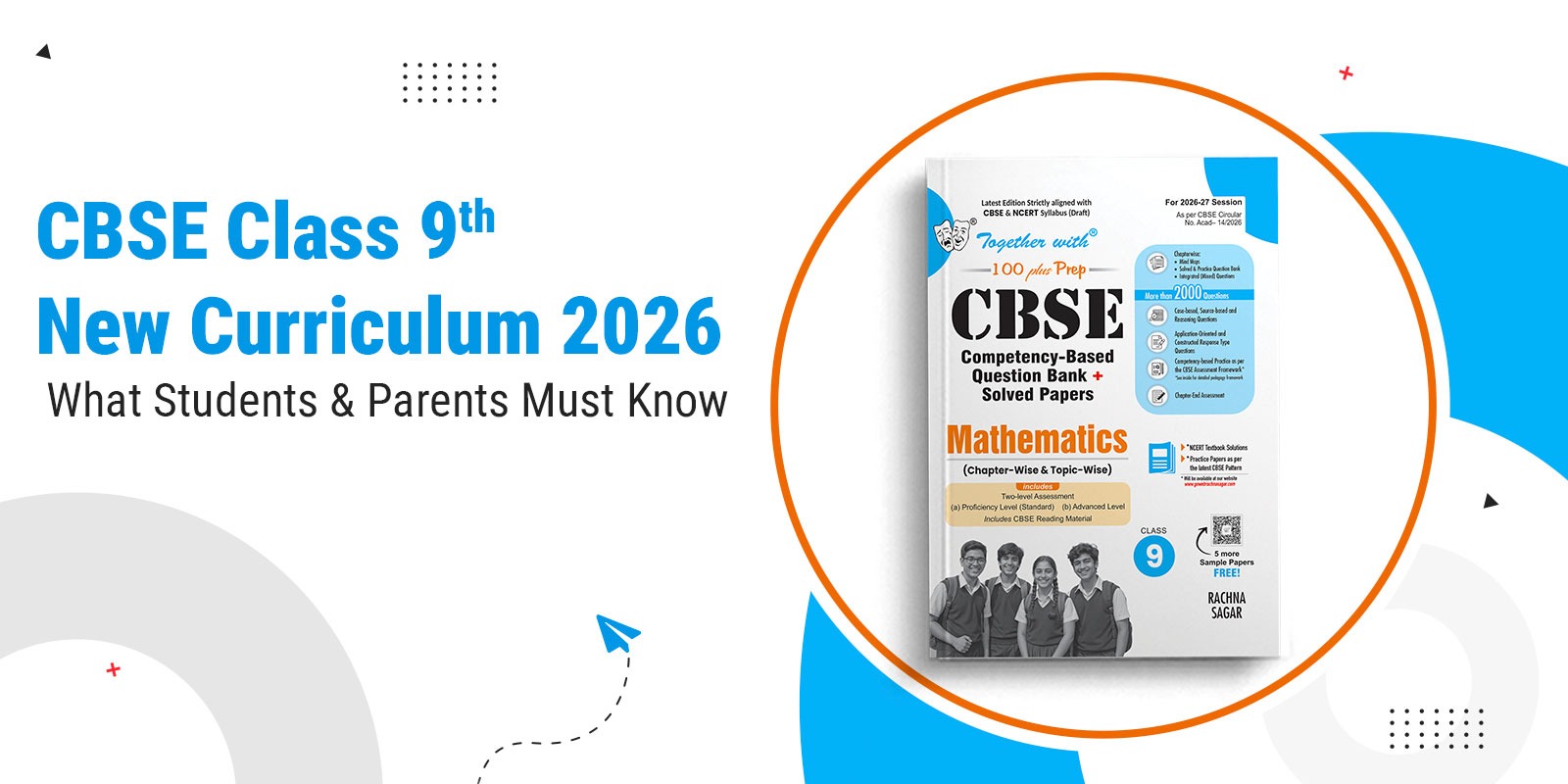


Understand the CBSE Class 9 New Curriculum 2026 aligned with NEP 2020 and NCF-SE 2023. Explore R1-R2-R3 language structure, competency-based learning, AI, assessments, and major syllabus changes students and parents must know.
The CBSE class 9 curriculum for the 2026-27 academic session got a major update to address how students will learn, prepare, and be assessed in secondary education. As per NEP 2022 & NCF-SE 2023, as per the CBSE latest update, the plan is to gradually shift from rote memorization to competency-baked learning, experiential education, and learner-centric teaching practices.
In simple terms, now students are no longer expected to memorize the books line by line. They are now expected to understand the concept, real life application, information analysis, effective communication and solve problems with logic.
This change became important for secondary classes starting from foundational class 9. Because it's the base for board exams. The revised framework is not limited to changed syllabus, but also revamping the complete approach of language learning, internal assessments, classroom teaching methods, project work, subject pathways, and the overall learning experience inside the schools.
For many students and parents, the confusion does not only revolve around “what changed in the class 9 syllabus”. But the major problem is that no-body simplifies the changes with technical terms used to introduce the change like competency-based learning, learning outcomes, formative assessment, and experiential pedagogy. While these terms may sound complicated, the actual objective behind them is simple: CBSE wants students to learn with understanding instead of depending entirely on memorisation.
The revised curriculum is aligned with NEP 2020 and NCF-SE 2023, where the main focus is on creating a more learner centric and future ready education system.
The framework clearly states that education must go beyond “content delivery” toward “competency attainment”. In reality, this means schools no longer need to focus only on completing chapters. Instead, the target is shifting toward whether students are really developing:
The curriculum also strongly supports inquiry based learning and experiential learning. Inquiry based learning encourages students to ask questions, investigate ideas, and think independently, while experiential learning focuses on “learn by doing yourself” though projects, experiments, activities, and discussions.
As a result, classrooms are expected to become more interactive and less dependent on passive note memorization.
In the 2026 academic year the key change in the CBSE Class 9 curriculum in regard to NEP has introduced a multilingual language structure which includes the R1, R2, and R3 pathways.
In simple terms:
CBSE’s base for this is not just in increasing the number of language subjects. What the board wants is for students to develop multilingual competency, communication skills, better comprehension and cultural awareness from the time they step into the school.
That is why language learning is no longer treated only as a scoring subject. The revised framework now focuses more on:
For students, this means language preparation may now require more classroom interaction, interpretation, communication based activities and analytical thinking instead of not just grammar exercises and memorized answers.
One of the major CBSE class 9 changes in the 2026 syllabus is the implementation of competency-based learning.
The term simply means students are now encouraged to understand and apply concepts instead of just reproducing textbook answers during exams.
According to the framework, competency based education places understanding, reasoning, application, and performance at the core of learning.
This completely alters the nature of preparation.
Instead of direct theory questions, students may increasingly face:
The new curriculum is also very close to connecting with “Learning Outcomes,” which define what students should actually know, understand, and be able to relate with real life after studying the topic.
In simple terms, completing the syllabus alone is no longer sufficient. CBSE now wants students to develop conceptual clarity and practical experience.
Another major change in the new curriculum is the fortifying of Internal Assessment practices.
The framework now includes:
“Multiple Assessment” means students will be evaluated through different approaches instead of depending only on written exams. Schools may now use quizzes, oral presentations, classroom discussions, practical activities, and collaborative tasks.
“Portfolio Assessment” tracks a student’s learning journey with the help of projects, assignments, reflections, presentations, and activity records. The goal is simple to measure competency attainment and overall learning growth curve instead of judging students only on the basis of final exam marks.
This means consistency, classroom participation, and active engagement may become more important than last-minute memorisation.
The CBSE class 9 syllabus 2026 also places greater attention to “Subject Enrichment Activities,” which are practical and application-oriented learning skills aimed to deepen conceptual understanding with inquiry, exploration, and experimentation.
In Science and Mathematics, students may engage in:
In Social Science, the framework encourages:
Meanwhile, language subjects may involve analytical writing, communication activities, and argumentation exercises.
This clearly reflects CBSE’s shift toward experiential and inquiry-driven learning rather than just prioritizing pure textbook-focused preparation.
The new curriculum introduces standard and advanced pathways for subjects like math and science.
The advanced track will cover additional syllabus material and also put more emphasis on Higher Order Thinking Skills (HOTS)-based questions, which majorly test in-depth conceptual understanding and analytical reasoning.
The purpose behind this system is to create differentiated learning pathways where students can choose academic depth according to their learning pace, confidence level, and future goals.
This reflects the larger NEP objective to make education more flexible and student-centered, in contrast to the current approach of placing all students in the same rigid academic structure.
The revised curriculum also introduces Computational Thinking and Artificial Intelligence (AI).
Computational Thinking does not simply mean coding. It refers to structured problem-solving, logical reasoning, pattern recognition, and analytical thinking.
CBSE emphasizes that these modules should remain competency-based and activity-driven instead of heavily dependent on expensive technology infrastructure.
The larger objective is to prepare students for a future where digital literacy and analytical skills will become increasingly important across careers and industries.
The revised framework repeatedly emphasizes “Pedagogical Practices,” which simply means teaching methods and classroom approaches.
CBSE latest update, now supports learner-centric pedagogy where teachers act more as facilitators instead of only lecture-based instructors.
This means classrooms are expected to become:
The framework also encourages collaborative learning, peer interaction, and emotionally safe learning environments where students feel comfortable asking questions and participating actively.
At the same time, CBSE is strengthening Art-Integrated Learning and interdisciplinary education. This approach uses creativity, storytelling, visual activities, and real-world connections to improve conceptual understanding and critical thinking.
The CBSE Class 9 syllabus 2026 is curated to drive a more skill-oriented, application-based, and future-ready education system. To fulfill CBSE and students' expectations as per the latest update, Rachna Sagar's Together With competency-based question banks and sample papers are available. Students who focus on conceptual understanding, competency-based preparation, and the latest syllabus-aligned learning resources will likely be accepted more confidently in the new academic structure, and together with the latest syllabus-based books, they are the must-have study material for targeting the board.
Kw: new curriculum CBSE, Class 9 changes, CBSE latest update, CBSE Class 9 syllabus 2026, New curriculum, latest syllabus based books

